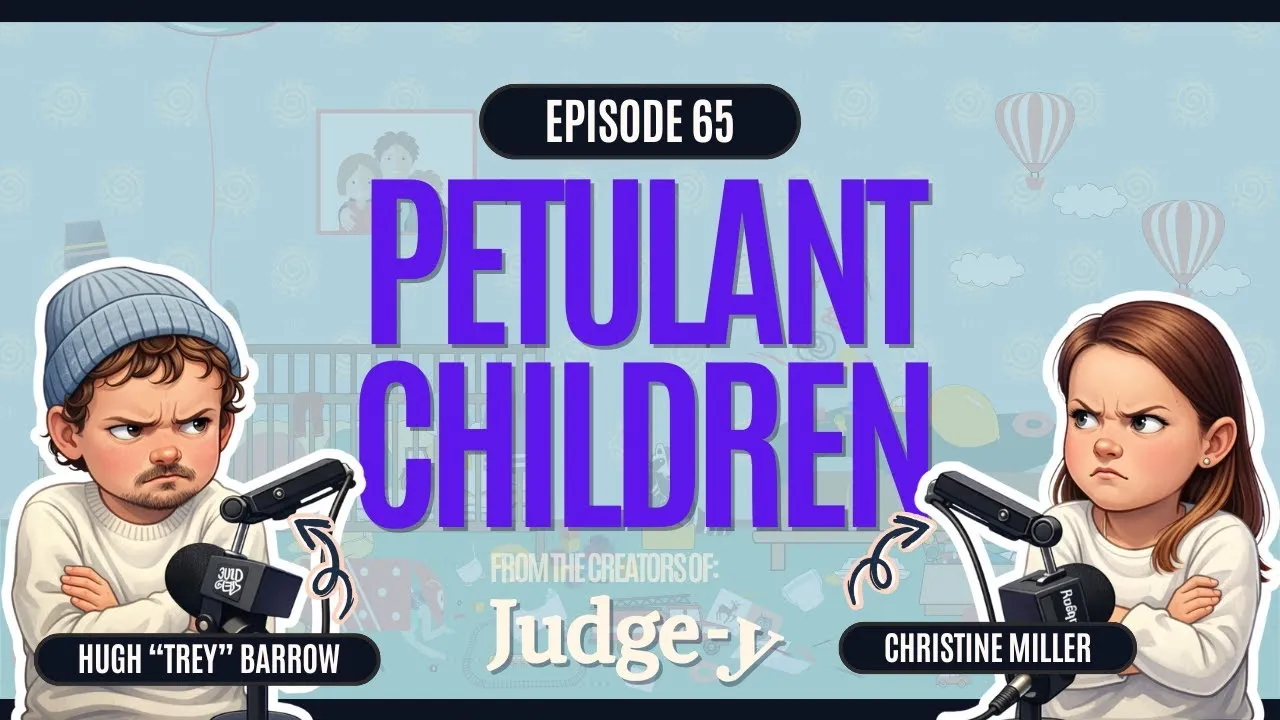
Episode 65
Petulant Children
About this episode
EPISODE 65: PETULANT CHILDREN In this episode, Christine dives deep into the judicial landscape of Bullitt County, Kentucky, examining the stark differences between the county's two family court divisions and sharing firsthand experiences practicing in front of Judges Elise Spainhour and Monica Meredith. KEY TOPICS DISCUSSED: Bullitt County Family Court Structure The evolution from a commissioner system to two family court divisions How landing in different divisions dramatically affects case outcomes The unique challenges of practicing in smaller counties versus Louisville Judge Elise Spainhour Consistent docket management and efficient case processing Tough but predictable courtroom demeanor The importance of judicial consistency for litigators Her involvement in substance abuse pilot programs and appropriate recusal Judge Monica Meredith Controversial rulings that gained national media attention The "move back in" order: A judge ordering divorcing spouses to live together The "too amicable" case: Denying a divorce because parties got along too well Concerns about judicial overreach and abuse of power Comparisons to other problematic judges discussed on the podcast Broader Issues: Small-town politics and the "good old boy" system The power dynamics between judges and local attorneys Deference given to certain court-appointed professionals Why judicial elections and challenges matter The difference between judicial incompetence and intentional overreach Notable Cases: The maintenance case where a wife was ordered to move back in with her husband during divorce proceedings The cooperative divorce case where the judge refused to grant a divorce because the parties were "too civil" The self-defense case involving allegations of abuse despite prosecutors clearing the defendant CONNECT WITH US: Website: judge-y.com Social Media: @Judgingthejudges LEGAL DISCLAIMER The content of this podcast is for informational and entertainment purposes only. It is not intended to be, and should not be construed as, legal advice. Engaging with this content does not create an attorney-client relationship between you and the hosts, guests, or their firms. The views and opinions expressed on this podcast are solely those of the individuals involved and do not necessarily reflect the official policy or position of any law firm, company, or organization. We make no representations or warranties regarding the accuracy, completeness, or applicability of the information presented. Any reliance on the information in this podcast is at your own risk. Laws are constantly changing, and every situation is unique. You should always seek the advice of a qualified attorney for your specific legal concerns.
Transcript
6,928 words · about 30 minutes to read. Automatically transcribed and lightly edited; speaker labels are approximate.
[00:00:00]
ChristineAll right. Bullitt County, y'all have been asking for it. , We're gonna talk about it.\\
ChristineYeah, I have, I practiced out there when they didn't have a family court judge, just had a commissioner and then their first family court judge who was someone that practiced there and had about half the damn cases in the county. So there was a big change. And then, when they got their second practice in front of her quite a bit, so. Yeah, I've seen a lot down there. I'm trying to think. When I came back in 2014, I remember making the rounds and going, introducing myself to all the judges because obviously starting to practice in a small town, that's what you learn. And so I think Monica Meredith's position was maybe added two years later. I could be wrong on that. But, I have got Monica Meredith stories for days and for context, the way the elections work, the family court judges in Bullitt County do not run at the same time. So the only seat on the [00:01:00] docket, LOL on the ballot is Monica Meredith currency and she's got a challenger. Yeah, I don't, I mean, people have challenged, I think people have challenged down there before since they've had family court judges, have they not? Oh no, they have actually, challenged span hour. I thought maybe, but not in my time that I can I could be, I could be remembering incorrectly. I mean, the spainhour are powerhouses down there, and I remember when I used to go sit through motion hour in the temp, they used to have this temporary courthouse. It was a big warehouse building. It was actually. It was pretty good. It was sort of like Bullitt, Oldham County is now but much, much bigger and in the smack, in the middle of a field, just like off the interstate, smack in the middle of the field building still there. But you'd walk in and, the courtrooms, you couldn't smoke, but every other place in the building you could smoke. So I remember like. You know, I would go out to my car after motion hour and if I needed to go pick up a file, I would strip down to my T-shirt so that my, I wouldn't have to dry clean my suit because the smoke hung so thick in the [00:02:00] clerk's office. You just have to wave it outta your way. But, I remember, John Spau, judge span hour's husband. Would be sitting at a table with stacks of cases and there'd be a paralegal just handing him cases and they'd just call his cases and you just sit there for like an hour while all the span hour cases came in. So when she, ran and became the first family court judge there, I just thought that seems. That seems like you may have, I mean, I don't know. That wouldn't make any sense if I had that many cases. I always wondered why you would want to do that when you had, you did so much business there, then all of a sudden you're, it's not like your husband can practice in front of anymore in front of you. So I, I didn't see him much after that, but, sounds like a good plan to get out of family court, make your spouse run in family court, and then you're conflicted out. You Oh, Can't go. You you imagine? Oh my gosh. oh my gosh. Yeah. So I know that was interesting 'cause I had not encountered her when she ran. I'd always, seen him and argued against him at motion hour, which it, , it was a pretty short period of time after I started practicing. Yeah. When [00:03:00] they had their family court, , when they. Got their first judge, judge Spau down there. And , she's still there. She's still there. And now the last election there was a contested when there was an open seat and it was Monica Meredith, and then an attorney that's passed away. And out of, there's a lot of, you know, I grew up in Bullitt County. There's a lot of fodder about this attorney, but. Out of respect for, it's just not worth to go down that rabbit hole. But it was a extremely vicious, vile campaign. And Monica Meredith, I don't, so I was raised by my stepfather, and so my family growing up had a different last name than me. And it's important for the story because I mean. Miller is my last name, but my family had a different last name . And I think when Monica took the bench, you have to understand obviously like the complexities. You grew up in a small town, you know how it is, right? Like it's like the good old boy system. But Monica Meredith, previously Monica Robinson was the county attorney and there was a shit ton of drama with that as well. But I guess the point of where I'm going is there [00:04:00] are a lot of. What's the right word? There's a lot of, there are a lot of factions and political, oh Moving pieces in Bullitt County. known for that. Yeah. Yeah. That's going on all over the state. I think I hear about it more in Bull County because we're right next door. Mm-hmm. So, I don't know if it's more there than a lot of other, small, medium sized towns, but there, there are a lot of things, a lot of moving parts down there. And you know, growing up I didn't realize, obviously, you know, I'm not a fan of that C word like corruption, but I definitely do think there are some ne nefarious things happening in Bullitt County. There's nefarious things happening in every county in Kentucky. But it's interesting. I have personal experiences with Monica Meredith as a litigator. My personal opinion is she is the top five worst judges that I've ever practiced in front of, and top two most retaliatory or vindictive in my opinion. So I was excited to see her seat challenged and she's got some really, questionable rulings that she's done that actually were so egregious or shocking that the media actually Oh, wow. [00:05:00] Yeah. Well, I mean, as you said, the Courier Journal has had journalists who would speak out and highlight things that judges have done in the past. he rest in peace, Andrew Wolfson. and yeah, and he did one that was sort of, hell, this was what, four years ago or something. He sort of did a. A, a list of bizarre rulings and sort of a, let's review some of the things coming out of this court. I will say my experience in Bullitt County has, I I've, it started in front of John Schmidt, the, , commissioner who I thought did a great job. He was, I thought the way they handled the commissioner stuff and the way they handled their docket actually worked really well. I wasn't surprised when they got a family court just because of the size and how the county was growing, but. I kinda liked, I, you know, I thought he would've been the good judge. He ran against, Elise Spainhour to be the first judge down there. Then when she took the bench, she was all about business. She moved through her docket very quickly. She, I definitely have had a lot of personal clashes with her, you know, just [00:06:00] those, you know, the way litigants and judges do. Yeah. And, man, she'll give you no quarter. She can, she can be really tough, but I I mean that, that was just sort of part of it. She kept the cases moving. She didn't let things linger forever. She wanted things moving along. One of the things actually that annoyed me the most, that's probably still really good docket management, but as a practitioner annoyed me, was that we would file uncontested divorces. Is When we filed them, the parties had already, yeah, signed the settlement. Like there was not going to be anything litigated, but you would still, every single one got scheduled for a case management conference. And because she wanted everything moving forward, no matter what it's gonna be on her docket. So she can ask what can we do to move this forward? Yeah. Which is pretty much the opposite of what you see in most places. So I always appreciated that. And I do like her docket management. You know, certainly I think probably at this point, 20, 25, 20 years on the binge, maybe not, but close to it for sure. Not quite, but yeah, getting close. Getting [00:07:00] close. I started in 2005. I started practicing down there probably term, so she's 26? Yeah, six. Yeah. So she was off the bench for a while, I think for health issues. And, . But, no, , I've, , I've had some issues. There was a pilot program down there that she was part of, which. Honestly, I think did a lot of good, but it created some issues in the family court where the pilot program would deal with people with substance abuse issues and she would be having conversations with people in that program and holding them to account and following their progress and, she was tough, but she's one of these people that was like tough, encouraging and you, I could see her being very good at like helping people. Move past that. The problem was she was, some of the people were also litigants in her courtroom. So there were these conversations about the stressors that are going on in their life, which might be their spouses, which might be being litigated in front of her. Yeah. And to her credit, when that was raised, she, recused herself from it. She didn't fight it 'cause she [00:08:00] recognized that. But, that was, was, and that gets to the small town we've talked before about like, the judges in Louisville are very hesitant to recuse. It's significantly easier to recuse and to have someone else handle a case in. Louisville because there's 10 of 'em. And when you're a solo judge in a county, it makes it much more complicated. You gotta get a special judge, but glad she upheld. But let's talk about Miss Meredith and , or just the notion, not even her in particular. I guess maybe what I am most excited to see is the fact that a family court judge. An incumbent has been challenged because last time we had an election cycle in Louisville of the 10, not a single person challenged That and that was strange to me because in the previous cycle, everybody that practiced family court, it seemed like they were running. because it was an open Yeah. No offense, but like everyone decides they wanna run and then when you have an incumbent, it's like, oh no, I don't. know. Yeah. I mean, make people campaign on the record. I know that's not how judges work. It's name recognition and you know, whatever else. Preaching to the choir, I get it. But, yeah, I mean, one of the things [00:09:00] that happened down there is you get used to judge Spau and man, she would let you have it. She would not take any BS if she thought your client wasn't telling the truth. She could be downright mean. Mm-hmm. And sometimes like that was, I don't know, there were times where that, that was tough, but you knew what you were getting. You knew what to expect. And you knew the case was gonna move forward and there were times where she was, I thought just downright mean to me. And then we would go back with counsel in chambers and she would be super professional and you could tell it was just making an impression on the client. Yeah. Which once I got used to that, I was all right with, so then we get the second division and man, you wanna talk about just a totally different world. Like I, it's, , now , I think the same thing about Hardin County, but before. It was hard for me to think of places where, which division you landed in would make such a difference. Like your case is going to be completely different based on where you land. Mm-hmm. And Bullet County was that sort of that [00:10:00] way for a long time in my practice, like, okay, we're in Bullet, where are we? What judge? Yes, It would make a dramatic difference. And y'all, for listeners, if you hear something, we've got Magneto, a special guest in the studio and he's sitting in my lap guest producer, but he refuses to sit behind the board and he just decides he wants to be a star diva. Oh my goodness. Where does he get it? But she was, when Monica. no one can see. Sorry. No one can actually see him , on the camera. Oh yeah, there he is. Hi. I think though, when she took the bench, like it was, she came out much like she did when she was the county attorney and like, this is my courtroom. Y'all are all gonna know your role. And that goes back to her not realizing, 'cause I came in as a quote unquote Louisville attorney on this case, and she thought, I'm gonna make this little girl know her role. Well I knew, I mean, I walked outside of the bailiff and he knew my. Stepdad and I was like, what is wrong with this woman? Like there is, and I mean, like you said, I had Spain hour one time, like a true southern woman tell [00:11:00] me that I was gonna go to hell in a way that I looked forward to the trip and I remember and I was, I it was appropriate. heard that. This, no, it was appropriate. 'cause I was, I interrupted her. Oh yeah. You don't only do that once. Yes you do. And I was making an argument and she was not finished. And. She didn't do it in a way, she, it was courtroom management. It was appropriate. And I realized immediately, Christine, know your role not in a, don't make an objection. Don't do your job. That's just, you can do that in 10 seconds. You know what I mean? I'm not done yet. And I do think with her, from a litigator perspective, you do realize, like, you know what you're gonna get, like you said. Exactly. I think that's a big part of litigation. Yeah. Is consistency. Even when I had judges that I knew couldn't calculate child support correctly, would make the same thing, and I'd have to correct them and have to file a, you know, have to file a motion to correct their calculate like. I could prepare for that. I could tell my client, [00:12:00] likely this is going to be calculated incorrectly or something. It'd be just, but just having that consistency and knowing what you're getting is very important. And that was one of the things that was Yeah. Difficult. Mm-hmm. When practicing in front of Meredith. Yeah. And I mean, I don't have any issue with the judge that comes in and says, these are the rules of my court. Exactly. It's a little bit different than others. And she had some very strict ones. You gotta file your exhibits in a very specific way. So many days before court or when you show up, you do not get to do them. There are no exceptions. And while that bit me, the very first time, 'cause I hadn't practiced, I hadn't tried a case in front of her. her. I mean, I get it. You sent something out. It clearly said that I had done it a different way. I didn't get to present those things. Fortunately, the other side had made the exact same mistake. So we talked about it, went in, tried the parts where we could try and, you know, it sort of. Worked around it. I'm all right with that. I'm all right. With people sitting, this is the role, this is how the, you know, I want the [00:13:00] cabinet to file a report. Like, those kinds of things I think are good management. But then you get, you don't get to then go beyond and say, okay, this is what I think the law is. Yeah. Yeah. And. You know, I think the law should be this, or I think this is what this means when it clearly, you know that. Yeah. And what she did to kind of abuse, I think abuse, her power was like she was filing bar complaints against attorneys, like an uncontested divorce. One attorney in particular for, the office notarizing signatures. Now, I don't necessarily think while she was a judge Yeah. For the office of the. Attorney notarizing signatures, even if it was the, it could have been, the attorney was notarizing both persons signatures, which I didn't do. It's not good No, it's not good practice. It was not, but no, there's nothing wrong with it. It's not a bar complaint. But she did that intentionally like because. It was very clear to me, at least in my opinion, that she was going to immediately come on, get, have the throne, you know? I'm sure she was like a Game of [00:14:00] Thrones. , And people used to laugh about that. Like she watched that a lot, which I love Game of Thrones. But it was like, okay, I'm going to attack Louisville lawyers to make them know their role. And then anybody that campaigned for my opponent, they're gonna know their role. Yeah, I, yeah, I don't know anything about that I didn't experience or Yeah, no, I know, but I'm just like, I have no knowledge or experience with that. I mean, I've talked to like Bullitt County attorneys that would get off of the elevator when she was county attorney because that's how, like the conflict between them, which is completely unnecessary and not helpful. It's, there's one thing to be adversarial, but you have to be professional and also, you know, not just for your own political aspirations. And I eventually was like, I'm not going back into this county, but it was just very funny, I think once she realized one. People were gonna stand up to her and two, you know what I mean? She doesn't have the. Background, I guess, but she just, I'm not a fan. I think to be very clear, there are some judges that I would probably struggle to be completely objective with. And I would say that she's one of them [00:15:00] after just seeing what I saw on both her dependency, neglect and abuse docket, her circuit court docket, and just generally speaking to people in the community, you know? Yeah. I mean my, I hear all the stories. I've read the cases, I've read the strange opinions. I've read the articles about the strange opinions, so, I know about that the same way so many attorneys do. Yeah. And people around the country that followed some of the really bizarre ones. Yeah. My personal opinion, I mean, my personal experience was, I had some rulings on evidence when I was trying to bring things in that is like, move on. That's not relevant. It was very important and I just, I couldn't get past that. And then there were some things like that. The things that affected my case, the cases, the worst I think were the deference given to, and this happens in a lot of smaller towns, smaller circuits where you might have a cabinet worker, GAL, somebody like that. There are just very few of them. And what I find. In most of the counties outside Jefferson County, they really work hard. They do a good job, they're overworked and most of the time they have too many cases. But [00:16:00] still, like these are the people that are answering the calls at like eight o'clock on Saturday and so they get naturally, they get a lot of difference. But there've been times where I saw. Interviews, forensic interviews with kids that were saying some pretty horrific and scary things, and the interviews were just correct, done so poorly that anyone watching would've realized that you gotta throw this out. This interview is, has not been conducted well enough. We need to go back through it to protect this kid. But because it was somebody that got deference there, it was just like, well, the interview didn't lead to anything, so we're gonna dismiss. And I felt that some kids were put in danger. I know I represented one side, so I had strong feelings in that way. But I also, you know, I will say I didn't have hearings that were just canceled at the last moment. I didn't have things put off forever. We got hearings, she moved the dockets forward and I actually got in front of her. Got cases resolved much more quickly than I do, and I did in almost anywhere else that I practiced. I mean, Bullitt [00:17:00] County was just a fast place to sort of move things through. I don't necessarily know that. I feel the same way. I'm trying to think about that specifically. But I do think that goes back though to like the small town notion of it. And I definitely think that she gave deference to cabinet workers, child support attorneys. Oh yeah. , Her court appointed, you know, there's like a group of, female attorneys out there that were all in a book club and they could do no wrong. Now there's, yeah, yeah. I encountered that. I didn't hear about that until after I encountered it. And I realized that like, wait a second, this person just, whatever they say happens. Yep. And, which is really like terrifying there. Now, there's one male attorney now that will get, if you're in Bullitt County, I mean, well, you know, you he will get deference in her courtroom for sure. But that's kind of the problem of the whole system. And so I think she did all this to make everybody in this. System kind of like, 'cause they're all scared of her for the most part. Not scared of her, like physically, but just like don't wanna deal with her wrath. And I think you extrapolate that over a, I said six years earlier, they're [00:18:00] eight year terms. My bad. Over an eight year term, then that's when you really start to see what the outcome of that is. Yeah, no, I agree. And I saw my clients just, you know, when they kept fighting, it kept getting worse and it was like, you're, she reacts to the client's continuing to. Fight for what they really believe in because she's already ruled that I'm not concerned about that. Yeah. And it just kept getting worse and worse. It felt like some retaliation against the clients. I never experienced it necessarily as retaliation against us, but I was never involved in any of the strange rulings we had, rulings we disagreed with, but some of the rulings that we're talking about, like we talk about on this podcast, , she has definitely issued some really strange rulings that have gotten national attention, but I wasn't involved in those cases. Now I have strong opinions about those cases, right? They are very troubling. But, I just, , they weren't my cases. So that wasn't personal experience. And And so what she did, y'all, in one case was she ordered, there was a motion for [00:19:00] maintenance filed by a wife in a divorce, and she ordered that the wife move back in with the husband. , Which is insane. Well, I, there's a lot of angles to it. So first and foremost, the people that talk about domestic violence and look at domestic violence statistically and things like that, came out and said, this could be a deadly situation. Now, there weren't allegations made in the petition in that case, and not saying that that case involved domestic violence, but there were some obvious concerns with ordering someone back in. But from my point of view, the bigger issue is. She has no power to do that. None. A judge in a divorce, actually, a judge in, I can't think of what kind of case in the United States where a judge has the ability to tell you where to live. Now if you are on release as a criminal, there can be some conditions and things like that, but you don't get to tell a private citizen, this is where you have to live. You may get to pick your own bedroom, but you're living at this house. No authority to do that, and that's, that's [00:20:00] just. Aside from the fact that you're making people going through a divorce, an already nasty situation, live in the same house, you're putting someone at risk and it could be either party. I mean, think about that. If it was, if the table, both parties, whatever, both of 'em wanna be married. But listen, but oh my Lord, you don't get to say you have to live in this place. You can deny maintenance. If you can say the pot of money isn't big enough to support the two households. You have a choice to make. You wanna live. Away. I'm not gonna grant you maintenance because I've made the findings under the law. There is no maintenance. You don't get to say you have to move back into a home. There's just, I, it is just strange why you would think that you can do that , And she thinks she can do anything and that's kind of how she operates her courtroom and makes these decisions. But let's talk about HIP. So judges in criminal courts, you can be awarded HIP, like that's home incarceration program. But if you are awarded HIP, you have to qualify. And by that, that means you have to have a residence. That's a privilege. That's something they're allowing you because you're [00:21:00] incarcerated. You're not a free person that then is being told where you have to live, they're not telling you. That's what I'm trying to say. HIP is not saying you have HIP to this address and you can't leave this address. So if you're on HIP, you do have to register your address, but if for some reason you move your HIP can move with you to your new So what you're saying is this person, this free person who has not been convicted of anything in a divorce, was told where to live and was given strict, it was stricter than, stricter requirements than someone who's incarcerated and gets HIP. Yes, I mean, HIP absolutely, because things happen. Like what if your home gets foreclosed on? You know, I mean, you have to have your address obviously registered to the ankle monitor, and if you leave the address where you're, it's not like instantaneous, but just the notion that a judge, and this is kind of goes to. Like we talk about our Ogden problem. This is the kind of power that this judge perceives that she has. And dangerous is an understatement. Like you [00:22:00] aren't God, you can't do that. I mean, so that's, I think that's a good analogy. The reason this is concerning to me, those types of rulings and that that type of behavior from the judge is the same reason I'm concerned, Ogden. Yeah. Is that the law doesn't allow for this. You think that, you know, instead of, I'm this person that's supposed to take the facts, interpret and then apply the law. Now all of a sudden you're just like, you're, you just get to tell people what to do and the law doesn't matter anymore. Right. Because there is no legal basis anywhere. Not not just in, in our domestic relations statutes in Kentucky, but any law that says you get to tell people where they can live. Yeah. And just say like, well, you guys use separate bedrooms. It's insane. And that gets to our next case. Well, it prohibited them from sleeping in the same bedroom, which is also, you can't do that. You have, you have jurisdiction over the marriage and certain [00:23:00] aspects of the divorce. Yeah. And you know, some financial status quo stuff, some maintenance, whether to grant the divorce, how to divide the property. Just because they're going through a divorce in your court doesn't mean they. Yours. And you can control anything, every aspect of their life you are, you have power over one aspect of their life. And by the way, it's voluntary power. They can just dismiss the divorce. Yeah. And you don't have that power anymore. So why do you think you get to tell people where they can live or what bedroom they can sleep It's Handmaid's Tale, and again, it's another female judge asserting power. that, mean, I've never seen a male judge even come close to ordering something like that. And I know not everybody, about gender. No. You've seen a male judge order somebody to not sleep in a bedroom with somebody or to sleep in a servant in a bedroom. that, but telling people what they can do personally is way outside of jurisdiction. Yeah. But I mean, nothing like this. And that gets to our next one. I I have. Yes. I. [00:24:00] It wasn't family court, I think in that it was a circuit court, an older male circuit court judge who happened to be, have jurisdiction over the family court stuff. 'cause they didn't have a family court. But I've seen a lot of personal restrictions that were absolutely, were not in the statute because that was just, you're getting a divorce in my court. This is how you're gonna conduct yourself during the divorce. So yeah, I've absolutely seen it. We need to figure it out. I wanna talk about it. But I just think as far as like the forward moving progression, we're moving in the opposite way. Yeah. I mean, again, to me it's just, it's simpler. You are there to exercise authority under specific statutes. Yeah. Read 'em. Commit 'em to memory, figure out where your authority begins and ends and stop acting outside of it. Yeah. That's not her problem though. I mean, she knows, I believe adamantly she knows she cannot do that. Yeah. I mean, but I also feel that way about Ogden. I mean, she's been told by the court of appeals she can't do things, and she just said, well, they don't do what I do. [00:25:00] Yeah. Like I don't have to, I don't have to listen. Yeah. So that's, that's my issue. I mean. The problem ultimately to the people in front of these judges is the same, whether the judge just doesn't know and has to figure it out, or if they're doing it intentionally. My concern is,, I think I'm more concerned with people , that are taking these actions intentionally than people that. Incompetent, and I don't know why. Mm-hmm. Same. I, but I don't know exactly why. It's something I struggle with because the problem's just as bad. The dangers to people are just as bad if the law's not being carried out or people are exercising outside or working outside their authority. But I don't know, it's I think, I don't know. I have less respect for evil two incompetence, I Exactly. And it's the intent to show dominance. You know, it's not going to go away and so it's gonna just grow and grow and grow. And then you have the case, the other case where this one did make national news, but you had. [00:26:00] Two parents, two married parents that got divorced, that worked everything out that were co-parenting that were, their child or children were thriving. They testified to all this, they worked out every last piece of their divorce. And the judge said, no, you can't get divorced. I want you guys to go co counseling. Yeah, because you get along too well. So it was interesting when the national media got a, you know, got ahold of that decision and talked to the attorneys, or at least one of the attorneys involved because I, I thought the response was perfect. You are basically telling litigants that an if you don't act like petulant children, I think those were the words, then you might not be allowed to get divorced. Yep. Which. For coming from an attorney like us, thinking about how much easier life is, how much better the outcomes are, how much more likely you are to get referrals when people , are mature and even if they don't like each other, can act responsibly and go through that [00:27:00] way. And to have a judge basically say, if you get along really well and work things out yourselves, I'm not going to divorce you. The implications for that, it's just hand tale. Well, well, for me it was almost just like. If that's the way it's gonna work, I quit. I'm gonna look for another profession 'cause I don't want to deal with everyone. You know, it's bad enough when you, when you have people that act like petulant children, but when people have to manufacture the, they look like they're petulant children when they really get along, then it's just gotten too bizarre for me. I'm out. And then you have a lot of people, you know, in the movement or online talking about family court reform or abolished family court talking about how family courts are designed to keep the conflict going. And you know, , whether I believe or don't believe that is irrelevant, but this is a perfect example of that. Y'all aren't fighting enough, you know? And so instead of letting you get divorced, I'm gonna order either way a therapist is getting fucking paid in family court. You guys aren't fighting and everything's working out. So go to counseling and work on your marriage. You know what I mean? Give the money to the lawyers, make more money and think about how much these parties paid. They, which [00:28:00] of court said, judge, we agree to everything. We want a divorce. Sign off of it on it. And it wasn't like the judge said, oh, this settlement is unconscionable. It was, y'all get along too well. I'm not doing that. I'm gonna pass it so the lawyers make more money. You know, it's the perfect example of the case that every single person in the bar should have said Enough is enough. You have got to go removed from the bench. Yeah. I mean, it's bad enough. We, in Kentucky at least, we have very clear statute that if part of the east reach. An agreement on all issues. The judge's only rule is to determine whether the agreement's constable or not. Yes. And if, unless they find that it's not if it, unless they find that it's unconscionable, they gotta, you know, sign the divorce, move them on. So it's not like this was a big gray area, but No, you know, you say that. You know, people always talk about family court is very good or has the motivation to continue the conflict. I don't think this is a good example. I think this is a whole different angle of that. It's doing exactly that, but I [00:29:00] think it's doing it in a totally different way than we normally see. I agree. I think that's, I think it's fascinating you say that. 'cause I didn't even think about it from, from that point of view, but it's just. It is crazy. I mean, that was shocking to me. But there's been some others, I mean, looking back at some of those the Courier Journal article I had forgotten about, you know, the, the case where someone fired a gun in self-defense. And, you know, prosecutors had found that it was proper self-defense. He wasn't charged with anything, but that she found that he had abused the grandchild by doing it in their presence, even though he was the one being attacked and had to fire the gun in self-defense. There's been some, there's been some bizarre things that have, I think, properly put her in the media, and it's been a few years, but I also think we don't have people that have the guts right now to follow those things and write stories about it anymore. And that's what we're doing and we get a lot of submissions about Bullitt County. And I get a lot of people here in Louisville too, like that will come up to me and be like, [00:30:00] what are you gonna talk about Spain Hour and Meredith? And we will, and we are. It's just a matter of having the time and the manpower to investigate all these cases because we are drowning in them. Drowning in them. I, yeah. I would be really interested to have a current ongoing case, someone to send us, for us to look at and to dig into, like we have with in division four. There's a whole bunch with Ogden in Jefferson County, but most of mine. My experiences were, were years past. So I, you know, and you know, the big things that got national news are now what, 3, 4, 5 years ago. It would be interested to see how things are going there now because of the, you know, people's, I get horror stories, I mean people horror stories. And you know, in all transparency, the person running against her is a GAL on the TikTok Judge's docket. So. You know, it's, I don't know, you know, it's there's one more day left for someone to potentially file in that [00:31:00] race. And it be, by the time people listen to this, what's coming out on Friday? Oh yeah, that's right. Mm-hmm. I'll come out tomorrow or, yeah, right. Yeah. so y'all can run down and file, you know, I don't know if anyone else will, and there'll be a primary, God bless God bless you if you do. Oh you do. my Lord. yeah. And then also just understand, you know, there are certain. People don't under God, I don't even know how to say this, like completely articulately or could like clearly. like Obviously if you file in Louisville, there's gonna be a certain level of retaliation, but the rules are played as far as these political fighting type things. They're very different in Louisville than they are in Bullitt County or in Montgomery County where I used to practice or Bath County. They all have their own, they come with their own risk. And I do, my personal opinion is that the fighting for judicial races can be much, much. Much more what's the right word? Vile, you know, Hatfields versus McCoy. Yes. In the counties. And they are in Louisville. In Louisville, [00:32:00] it's much more like a hand chosen or predetermined. Are you a, you know what I mean? Or how many, how many signs can you put up? How many flyers and signs can you put up or steal of the opponents from people's yards? know, it's like, are you gonna give the blowjob to the unions and shit? Like that kind of thing. Wow. Happy Friday yeah, do that. And then they don't endorse you anyway, which is always even, Oh, how'd you know? That's what I did. No, I'm just kidding. Too much. I, oh shit. Okay. I was, that was, I was not referring to that. I was referring to something much longer, long before you ever ran. that did not happen. But there is a, there's a different political game and I've seen it and I've seen it up close, like in both different arenas. So I digress. Will we leave that in? Will we cut it out? Happy Friday. Happy Friday.
Speaker 6[00:33:00] Yeah. Yeah. We need some. Justice. Justin found justice.
Speaker 2Content of this podcast is for informational and entertainment purposes only. It is not intended to be and should not be construed as legal advice. Engaging with this content does not create an attorney-client relationship between you and the hosts, guests, or their firms. The views and opinions expressed on this podcast are solely those of the individuals involved and do not necessarily reflect the official policy or position of any law firm, company or organization. We make no representations or warranties regarding the accuracy, completeness, or applicability of the information presented. Any reliance on the information in this podcast is at your own risk. Laws are constantly changing and every situation is unique. You should always seek the advice of a qualified attorney for your specific legal concerns.